

Email traffic should not be counted as organic search traffic, but it can assist conversions that begin with—or later include—organic search. The right measurement setup separates channels while showing how email and SEO contribute across the same customer journey.
This guide explains how to measure that relationship in Google Analytics 4 (GA4) without presenting email clicks, repeat visits, or engagement metrics as direct search-ranking factors.
\n\n
If you are still deciding how the channels differ strategically, start with our comparison of email marketing vs. SEO, including costs, timing, audiences, and use cases.
What Is an Email-Assisted SEO Conversion?
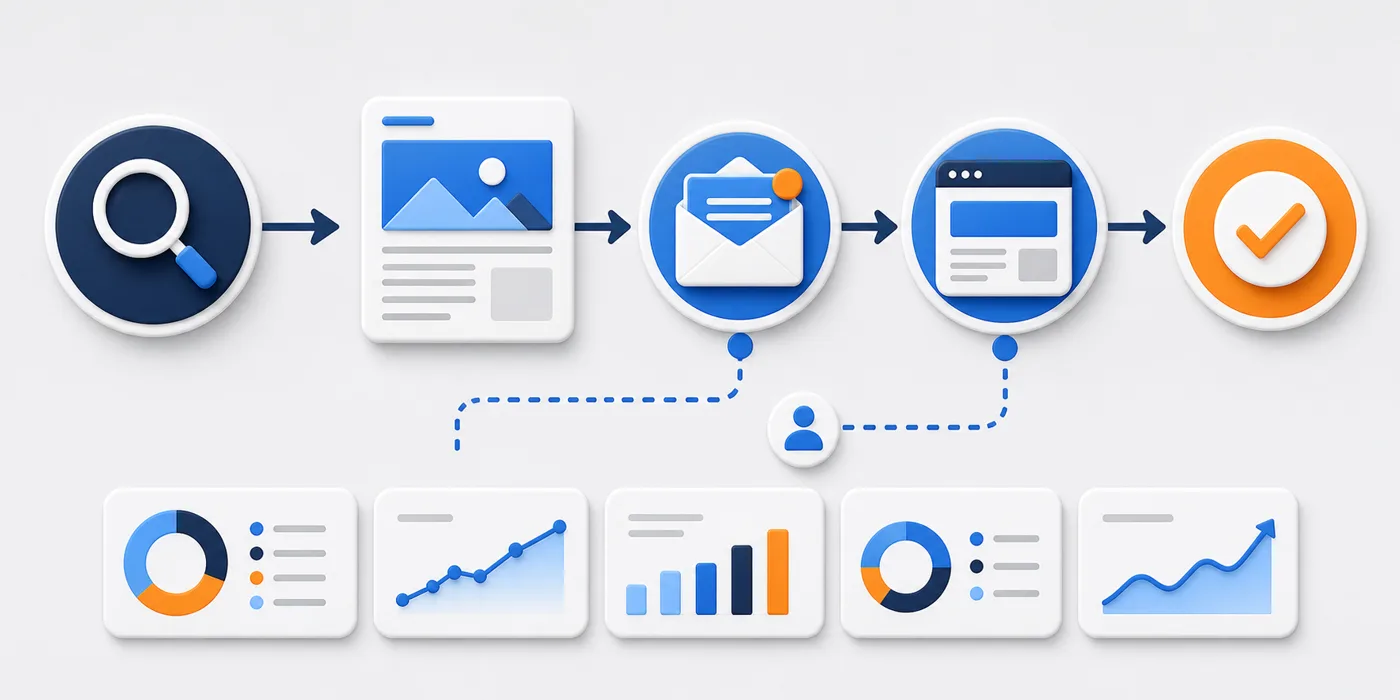
An email-assisted SEO conversion occurs when email and organic search both contribute to a path that ends in a meaningful action, such as a lead form, scheduled consultation, phone call, purchase, or qualified content download.
For example, a prospect might discover an article through Google, subscribe to a newsletter, return through a tagged email campaign, and later submit a contact form. Another prospect may first encounter the brand through email and return through a branded Google search before converting. Neither journey should be attributed entirely to one channel.
This distinction complements our guide to how email marketing supports SEO: email does not directly increase rankings, but it can distribute content, encourage return visits, and keep useful resources visible to the people most likely to act on them.
Start With Consistent UTM Parameters
Every campaign link should include a consistent set of UTM parameters. Google recommends using at least utm_source, utm_medium, and utm_campaign so campaign traffic can be identified in acquisition reports.
utm_source: identify the newsletter, platform, or audience sourceutm_medium=email: keep the channel classification consistentutm_campaign: identify the promotion, content theme, or lifecycle campaignutm_content: distinguish buttons, text links, creative versions, or placements
A tagged article link might look like this:
https://example.com/guide/?utm_source=client_newsletter&utm_medium=email&utm_campaign=seo_content_series&utm_content=primary_cta
UTM values are case-sensitive, so establish a naming convention before campaigns launch. Using both Email and email, for example, can fragment reporting. Google provides additional guidance in its campaign URL documentation.
Define the Conversions That Matter
Traffic alone does not show whether email and SEO create business value. Configure GA4 key events around actions that reflect genuine progress through the customer journey.
- Qualified form submissions
- Booked consultations or appointments
- Tracked phone calls
- Purchases or completed checkouts
- Demo or estimate requests
- High-intent downloads when they represent a real lead
Avoid treating every scroll, page view, or button click as a primary conversion. Those events can help diagnose behavior, but inflating the conversion count makes channel comparisons less useful.
Separate Session Performance From Conversion Paths
GA4’s Traffic acquisition report explains what brought users into a particular session. Use dimensions such as Session default channel group, Session source/medium, and Session campaign to evaluate email traffic separately from Organic Search.
Then use the Attribution paths report to understand the sequence of touchpoints before key events. Google describes this report as a way to see which channels initiate, assist, and close conversion journeys. Review paths that include both Email and Organic Search rather than relying only on the final session.
This two-report approach answers different questions:
- Traffic acquisition: What happened during sessions attributed to a particular email campaign?
- Attribution paths: Where did email and organic search appear before a key event?
Build a Practical GA4 Analysis
1. Review email campaign sessions
Open the Traffic acquisition or Manual campaigns report and filter the medium to email. Compare sessions, engaged sessions, key events, and revenue or lead value by campaign.
2. Review organic landing pages promoted by email
Create a list of SEO-focused pages included in newsletters. Compare their organic and email performance separately, looking for changes in qualified visits, subscriptions, assisted leads, and earned links after promotion.
3. Inspect mixed-channel paths
In Attribution paths, isolate journeys that contain both Email and Organic Search. Note whether email appears earlier, later, or repeatedly before the conversion.
4. Compare branded and nonbranded search trends
Use Google Search Console—not GA4—to evaluate search queries and landing-page visibility. Email campaigns can coincide with increased branded interest, but correlation should not be described as proof that email improved rankings.
5. Report outcomes by content asset
Track which guides, case studies, and service pages attract organic visitors, earn email clicks, and participate in conversion paths. This helps the SEO strategy and email marketing strategy prioritize content with demonstrated audience and business value.
Metrics Worth Reporting Together
- Email sessions and engaged sessions
- Email-attributed key events
- Conversion paths containing both Email and Organic Search
- Organic entrances to email-promoted landing pages
- Newsletter subscriptions originating from organic landing pages
- Branded-query impressions and clicks in Search Console
- Qualified leads or revenue associated with promoted content
- Editorial backlinks earned by promoted resources
Report these metrics as complementary evidence. Do not combine email and organic sessions into a single traffic number or imply that campaign engagement is a Google ranking signal.
Common Measurement Mistakes
- Missing or inconsistent UTMs: untagged email clicks may appear as direct traffic or become difficult to identify.
- Using last-click reporting alone: the final interaction can hide earlier organic or email touchpoints.
- Calling email traffic organic traffic: the channels should remain separate even when they support the same outcome.
- Tracking low-value actions as primary conversions: this makes campaigns appear more effective than they are.
- Assuming correlation proves ranking impact: an increase in traffic or branded searches after a campaign does not prove that email caused a ranking change.
- Ignoring privacy and consent settings: measurement should respect the site’s consent configuration and applicable privacy requirements.
A Simple Monthly Reporting Framework
Begin with channel-specific performance, add conversion-path analysis, and finish with business outcomes. A concise monthly report can include:
- Email campaign traffic and key events
- Organic performance for promoted pages
- Paths in which Email and Organic Search both appeared
- Leads, revenue, subscriptions, or backlinks associated with those assets
- Recommended content and campaign actions for the next month
The goal is not to force credit onto one channel. It is to understand how search discovery, owned-audience distribution, and return visits work together to produce measurable results.
Need help connecting your analytics, email campaigns, and organic-search reporting? Talk with One With Digital about building a measurement plan around qualified leads and revenue.
Frequently Asked Questions
Do email clicks count as organic traffic in GA4?
No. Properly tagged email clicks should appear under the Email channel or the corresponding source and medium, not Organic Search.
Can GA4 show whether email assisted an SEO conversion?
GA4’s attribution-path reporting can show journeys containing both Email and Organic Search before a key event. The available data depends on the property’s tracking, consent, retention, and attribution configuration.
Should every email link use UTM parameters?
Links to your website should use consistent campaign parameters when you need campaign-level reporting. At minimum, use a standardized source, medium, and campaign.
Does increased branded search prove email improved SEO?
No. Increased branded search can indicate growing awareness, but it does not prove that email directly changed rankings. Evaluate it alongside Search Console, campaign, and conversion-path data.
Next step: Use our practical plan for combining SEO and email marketing to turn the strategy into a coordinated campaign.